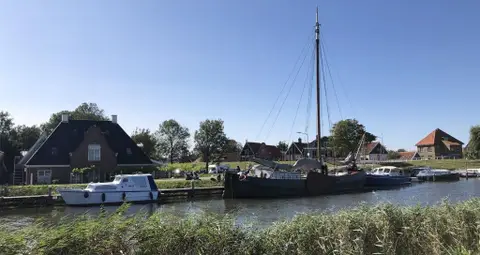
Kolhorn lies amidst the meadows. If you look closely at the picturesque location of this small village behind the dike, you can easily imagine that Kolhorn used to be situated on the Zuiderzee. Since the land reclamation, the former fishing village lies in the heart of the West Frisian landscape and has a protected village appearance.
Omval-Kolhorn
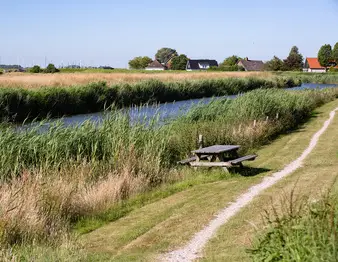
On the way to the linear village of Obdam, you walk along the Westfriese Omringdijk into the Old Land of the West Frisians: you are now in a peatland with many traditional Dutch farmhouses and linear villages. You pass dikes, winding peat rivers, straight canals, and old reclaimed land. The landscape is varied, with many small bridges and stepping stones. And tall grass, because due to nature conservation, the grass here is only mowed twice a year. Good (waterproof) walking shoes and long trousers are therefore a godsend. The Omval-Kolhorn nature corridor is also located along the Noord-Hollandpad. Since its completion in 2013, the banks have provided shelter and breeding grounds for birds and fish.
Irish Cottage
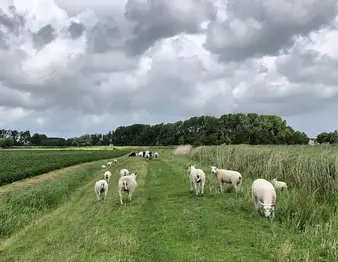
Passing through various small, typical North Holland villages, you arrive in Verlaat, where the Irish Cottage is located. You will feast your eyes on the sheer number of whiskies on display here. The extensive menu features, among other things, pancakes with maple syrup and fresh strawberries. Highly recommended! The village of Verlaat owes its name to the Niedorp lock, through which ships were passed until 1942. Along the water lies the old 's Lands Welvaren Inn, now converted into a stately residence. Old Niedorp is a typical linear village. The bulb industry is encroaching on the landscape, but meadows and windmills still dominate the scenery. Red cabbage and white cabbage are clearly the region's favorites. The spectacular North Holland skies and landscapes, with cows and horses and grassy dikes dotted with sheep, are beautiful. The Obdammermolen slowly comes into view.
Most beautiful church in North Holland
The name says it all: Obdam was built on a dam. This former fishing village was founded around 1100 in a very wet peat area. The people of Obdam were the first to dike the area with a transverse dike to protect themselves against the water. The glory of yesteryear can be found in Obdam's characteristic train station and in the St. Victor Church.