This short but exhilarating stage is a mix of pleasant, quiet country lanes and unpaved church paths, of straight canals and winding ditches, peat meadows and grassy dikes with plenty of stiles. And of windmills, for here you are surrounded by many reclaimed lands where, in the 17th century, entire windmill parks created new land. You walk below sea level in this region, hence the name Laag-Holland (Low Holland).
Obdam
Obdam, situated on the dam, was also freed from the expanding lake around 1600, just like Polder de Wogmeer. Of the six windmills that kept the area dry, Poldermolen Nieuw Leven – on the route of the Noord-Hollandpad – is the only one remaining. Further along near Rustenburg stand three more striking windmills. You are approximately halfway through the stage here, so café-restaurant de Gouden Karper is a nice spot for a stop.
Meadow birds
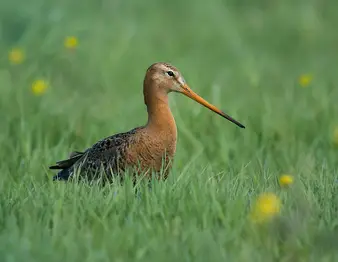
Continue to enjoy the peace and space here. Meadow birds also like it here. In spring, black-tailed godwits and redshanks can be clearly heard. But you will also encounter the little plover, wood sandpiper, avocet, and moorhen here. Nature organizations and farmers are doing everything they can to protect the meadow birds.
Schermereiland
The Schermerhorn terminus is located on what was once the Schermereiland. The island was formed in the Middle Ages because sections of peat were washed away in the connected peatland behind the North Holland dunes. This resulted in the formation of large lakes such as the Schermeer and the Beemstermeer. The first sources regarding the inhabitants of the Schermereiland date from after that time. The inhabitants lived from agriculture and fishing, and later also from herring fishing and whaling. When the Beemster was drained in 1612 and the Schermer in 1635, the Schermereiland ceased to be an island.
Schermerhorn
Close to Schermerhorn, you can still see a few preserved windmills that were responsible for the land reclamation. For the history of the Schermereiland, you must go to De Rijp, to the Museum in 't Houten Huis. You can learn more about the maritime past of this region in the Reformed Church of Schermerhorn, near the end point of this stage.