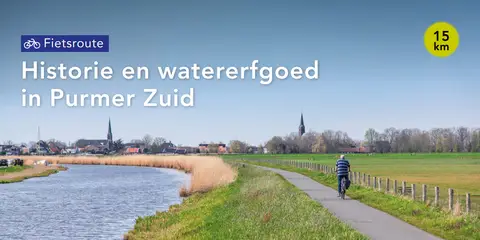
Start in Purmerend and cycle 52.5 km past seven forts of the Amsterdam Defence Line in the green Beemster landscape. Discover UNESCO heritage sites, polders, and historic villages.
Cycling past forts and polder
This 52.5-kilometer recreational cycle route takes you through the heart of the Beemster, one of the most beautiful UNESCO World Heritage polder areas in the Netherlands. You cycle past seven forts and a historic inundation lock of the Defence Line of Amsterdam – the 19th-century defence line surrounding the capital. Along the way, you pass endless polder ditches, ride along quiet dike roads, and experience the tranquility of Low Holland.
Directions
You start at Parking Lot De Populier in the Purmerbos, on the Westerweg in Purmerend (1447 AB). From the forest, you soon cycle into the open polder landscape of the Beemster. The vastness strikes you immediately: a flat, green carpet of meadows, perfectly straight ditches, and wide dikes along which you have views stretching far into the distance.
You pass in succession the Fort on the Nekkerweg, the historic Inundation Lock in the Southern Beemster Ring Dyke, the Fort on the Middenweg, the Fort on the Jisperweg, and the imposing Fort at Spijkerboor – the most heavily armed fort in this part of the Defence Line.
Next, you drive past Fort Benoorden Purmerend and the unique, never-completed Fort bij Kwadijk in the Zeevang. You traverse picturesque towns such as Middenbeemster, De Rijp, Edam, Volendam, and Monnickendam, each with monumental facades, historic canals, and cozy terraces. Via a loop through the Zeevang, you return to the starting point in Purmerend.
The route largely follows quiet country lanes and dikes via the cycle node network. You ride through an open, flat landscape and experience no crowds anywhere. From the ring dikes, you look out over the lower-lying polders – a striking example of Dutch water management.
Highlights along the way
- Fort aan de Nekkerweg – Former military prison, now converted into an eco-chic wellness resort with two restaurants and 16 rooms.
- Fort Spijkerboor – The most important fort of the Northern Front, equipped with a rotating armored turret. Reopens to visitors in 2026.
- Fort aan de Middenweg – Surrounded by unique dune vegetation and home to the long-eared owl and freshwater shrimp.
- Fort Benoorden Purmerend – Currently used as a wine storage facility; converted into a dwelling by a wine importer.
- Fort bij Kwadijk – Unique: this fort was never completed. Only the fort keeper's house and the engineering shed remain.
- Beemsterringdijk Floodgate – Used in 1940 to flood the Beemster. A rare reminder of the defense of the Netherlands.
- Villages of Edam, Volendam, and Monnickendam – Historic canal towns with monumental architecture and cozy terraces.
Background story
The Amsterdam Defence Line was constructed between 1880 and 1914 as a ring of forts stretching 15 to 20 kilometers around Amsterdam. In the event of a threat, the land between the forts could be flooded – too shallow for boats, too deep for men and horses. The forts in the Beemster formed part of the northern front of this line. In 1996, UNESCO recognized the Defence Line as a World Heritage Site. The Beemster polder itself, drained in 1612, had already been on the UNESCO list for some time. This makes the Green Defence Line Route unique: you cycle through a landscape with a double UNESCO status.
Practical information
- Distance: 52.5 km (loop)
- Route type: Recreational cycle route via the junction network
- Starting and ending point: De Populier Parking Lot, Purmerbos, Westerweg, 1447 AB Purmerend
- Signage: Follow the cycle nodes: 29 – 30 – 26 – 25 – 46 – 43 – 60 – 06 – 07 – 08 – 09 – 04 – 94 – 95 – 56 – 55 – 56 – 18 – 29
- GPX download: Available via the route page
- Wheelchair/stroller: Limited suitability; dike roads can be narrow
- Accessibility by public transport: Purmerend is easily accessible by train (Purmerend station) and bus. From the station, you can cycle to the starting point in the Purmerbos in just a few minutes. An ideal way to leave the car at home!
- Seasonal tip: In spring, the meadows surrounding the forts are in bloom, and during the breeding season (April–June), you can spot special birds such as the little owl and the golden oriole in the fort moats.
- Please note: Fort bij Spijkerboor will not be accessible to visitors again until 2026. Fort aan de Middenweg can only be admired from the outside.
- More information: This route was compiled by the ANWB .
This route revolves around the Amsterdam Defence Line, a UNESCO World Heritage Site, and the rich history of the Beemster Polder and the Dutch Water Lines.