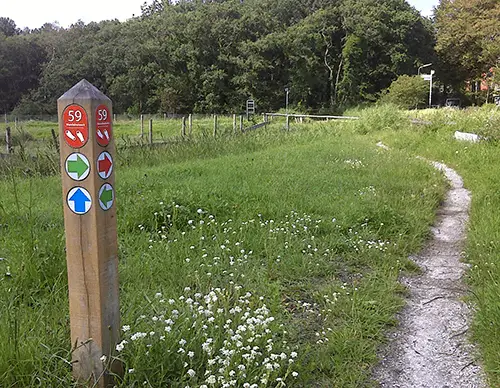
Walk 5.2 km along the southern outer dike edge of Kwadijk, over the Purmer ring dike and past the former station building — a quiet Westfriesland route.
Step back in time
The Kwadijkeroog Loop (blue) is a compact yet surprisingly rich 5.2 km walk through a forgotten corner of the Zaanstreek-Waterland region. You explore the outer southern edge of the centuries-old village of Kwadijk, which owes its name to the "bad" — difficult to maintain — dike along the Purmer. Here, you feel how thin the boundary between land and water is. The route returns via the ring dike of the reclaimed Purmer and past the former Kwadijk station, which served the Zaandam–Enkhuizen railway line from 1884 to 1938.
Between dike, polder and railway
You start in Kwadijk, a small village in the municipality of Edam-Volendam with fewer than a thousand inhabitants. Immediately, it feels different here from the hustle and bustle of Purmerend, which you soon see looming on the southern edge. The route zigzags along the strips outside the dikes, past the former 'banne' (jurisdiction) of Kwadijk. You walk along narrow polder paths, surrounded by low peat meadows and ditches full of reeds. In the distance, you hear the clatter of ducks and the wind rustling through the reed beds.
Afterwards, the route climbs the ring dike of the Purmer — the embankment that girdles this reclaimed inland sea. Here you have a wide view over the open polder plain and the grasslands stretching to the horizon. On clear days, you can see the skyline of Purmerend and the contours of the Markermeer. Returning towards Kwadijk, you pass the site of the former station. The small station was initially called Kwadijk-Edam and used to attract steam tram passengers from the direction of Edam as well. Between 1906 and 1933, a steam tram even ran from Kwadijk to Volendam. In spring and summer, the ditch banks are filled with yellow iris, marsh chicory, and various reed birds marking their territory.
Highlights along the way
- Purmer Outer Dike Edge — The narrow strip of land outside the Purmer ring dike offers a unique perspective on the polder landscape: lower than you perceive, surrounded by water and vistas.
- Purmer Ring Dike — The historic ring dike offers a panoramic view of the Purmer. Walking on the dike gives a sense of space that you wouldn't immediately expect here.
- Former Kwadijk Station (1884–1938) — Along the route, you pass the site of the old station building on the Zaandam–Enkhuizen railway line. A silent witness to a time when this village was a hub for both train and steam tram.
- Church of Kwadijk (1835) — The village has a striking Reformed church that replaced an earlier cruciform church in the nineteenth century. A modest but distinctive brick building that defines the village skyline.
A village that deserves its name
Kwadijk owes its name to the 'kwade dijk' — a section of dike that was notorious in the Middle Ages for its poor maintenance. The village itself originated as a successor to the even older Drei, which became uninhabitable due to peat subsidence. Traces of the vanished Drei were not rediscovered until the twentieth century during archaeological research. Kwadijk also had a rich history as a sailors' and livestock-farming village, situated in the midst of the water-rich Zeevang landscape that so characterizes the province of North Holland.
Tips and practical information
- Dogs: Dogs are welcome on this route; keep an eye on them near livestock in the pasture.
- Accessibility by public transport: The nearest train station is Purmerend. From Purmerend, take the bus to Kwadijk — this way you leave the car at home and board the route directly.
- Marking: The route is marked with blue arrows and signs; follow the blue color through the village and the polder.
- Accessibility: The route follows narrow dike paths and grassy polder paths; limited suitability for strollers, not suitable for wheelchairs.
- Season: During the breeding season (March–July), be extra careful along the ditch banks; reed birds nest close to the path. In autumn and winter, the ring dike is beautifully bare and rugged.
- Tip: Combine the walk with a visit to nearby Edam (within cycling distance) for a café or cheese shop.