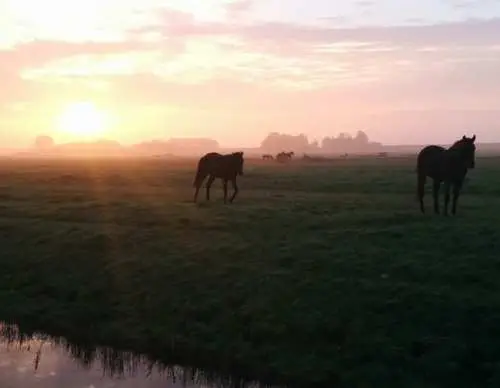
Walk along the historic West Frisian Ring Dyke with wide views of the Markermeer and through the picturesque village of Schellinkhout — 7.8 km.
Dike, village and the wide horizon
The Uiterdijk Route (blue) takes you along one of North Holland's most remarkable water-retaining monuments: the West Frisian Ring Dyke. From the Schellinkhouterdijk, you have an unobstructed view of the Markermeer, while the quiet village of Schellinkhout offers a glimpse into authentic West Frisia. This 7.8 km circular walk is a hidden gem in the West Frisia region — few tourists, abundant scenic richness.
Over the dike and through the village
You start the walk on the Westfriese Omringdijk, where you immediately feel surrounded by air and water. To your left, the Markermeer stretches out endlessly; on a clear day, you can see the outlines of Flevoland on the other side. The wind smells of water and grass, and seagulls circle above the breakwaters. You walk along the historic Schellinkhouterdijk, part of the 126 km long Westfriese Omringdijk, which has protected the land from the water for centuries.
After a while on the open dike, the route descends into the inland landscape. You pass the Binnen- and Buiten-Uiterdijk, the area outside the dike from which the route derives its name. Here stood the 17th-century Grote Molen (a national monument), which, together with the pumping station from 1900, ensured the drainage of the polder. Both monuments are still clearly visible along the route. Afterwards, you walk through the village center of Schellinkhout. The narrow Dorpsweg, the characteristic West Frisian houses, and the atmospheric Martinus Church give the feeling that time moves much slower here. At the end of the village, the route leads you back to the dike, from where you complete the final meters with the Markermeer by your side.
Highlights along the way
- West Frisian Ring Dyke — A 126 km long historic dyke that has protected West Frisia for centuries. A provincial monument with an impressive view over the Markermeer.
- View over the Markermeer — From the dike, you have a wide, open panorama over the water. Ideal for birdwatchers: grebes, geese, and cormorants can regularly be seen here.
- The Great Mill and Pumping Station Schellinkhout — A 17th-century polder mill and a pumping station from 1900, both national monuments. Together, they tell the story of a centuries-long struggle against the water.
- St. Martin's Church Schellinkhout — A characteristic village church, the oldest part of which possibly dates from the 14th century. The rustic little church stands in the middle of the village and adds atmosphere to passers-by.
- Schellinkhout Town Hall (1765) — This small town hall with a weigh house was built on the site where the foundation stone was laid in 1759. A special reminder of Schellinkhout's past as a city with city rights.
Battle against the water — a story of centuries
Schellinkhout is situated on the edge of the West Frisian Ring Dyke, a dyke that was not constructed all at once but grew over the centuries. From the tenth century onwards, the West Frisians built increasingly higher dykes to protect their land. After the completion of the Afsluitdijk in 1932, the Ring Dyke lost its sea-defending function, but the provincial monument still serves as a reminder of this tenacious struggle. Schellinkhout itself was granted city rights as early as 1402 — and yet has always preserved its rural character.
Tips and practical information
- Public transport accessibility: Hoorn is the nearest station, approximately 3 km from Schellinkhout. From Hoorn station, you can take the bus to Schellinkhout or combine the route with cycling. This way, you can leave your car at home.
- Marking: The route is marked with blue arrows and/or blue-colored route posts. Follow the blue signage.
- Dogs: Dogs are allowed on the route. Please observe leash requirement zones near breeding areas along the dike (especially during the breeding season: March–July).
- Accessibility: The route runs partly along dike paths and unpaved roads. Not suitable for wheelchairs or strollers.
- Season: Most beautiful in spring (flowering grasslands) and summer (long daylight, wide horizon). In autumn and winter, the storms on the Markermeer are impressive. Part of this route is closed from March 1, 2026, to July 1, 2026, due to the breeding season.
- Please note: Dike paths can be slippery in the rain. Wear sturdy footwear.
Kenmerken
- Onverhard
- Honden niet toegestaan