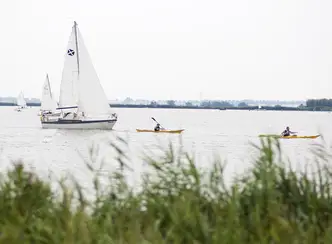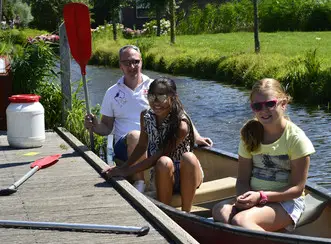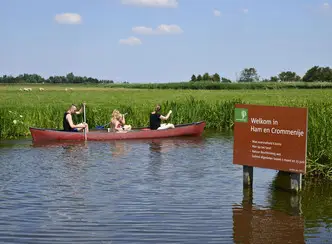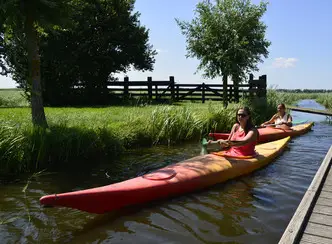
A pleasant boating route through a nature-rich area with historical elements, ideal for a relaxing day on the water with family or friends.
Around the year 1100, a connection formed at this location between the Schermer, a peat stream situated to the north, and the Wijckermeer, an offshoot of the IJ. The body of water thus formed was given the name the ' Cromme IJe' . For a long time, this water was the most important shipping route between the city of Alkmaar and cities such as Haarlem, Leiden, Gouda, and Amsterdam. The construction of dams, initially still with locks but later completely closed, put an end to its function as a shipping route.
Today, the Crommenije forms part of an extensive nature reserve. Siltation is taking place on the western banks. This creates a succession of vegetation types with a rich variety of plant life, including rare species such as sphagnum moss, marsh orchid, and carnivorous sundew. The succession ends in swamp forest, which is found in many places along the western bank. Reed beds and thickets provide shelter for birds and insects.
The small dike along the canoe route is a so-called inundation dike. It was constructed around 1900 as part of the Defence Line of Amsterdam. In times of war, the farmlands to the north of this had to be able to be flooded (inundated) with water from the Alkmaar Lake.
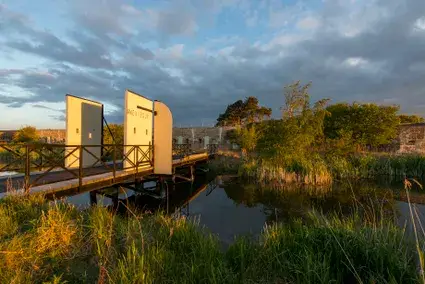
In peacetime, farmers from Krommenie needed to be able to reach the farmlands north of Krommeniedijk with their boats. Therefore, a break was made in the inundation dike, a so-called navigation revetment. In peacetime, this was open. During inundation, bulkheads were installed on both sides. The space between them was filled with sand.
The fort and the surrounding meadows are clearly visible from the Lagendijk. The fort guarded the Lagendijk towards Uitgeest. On the yard across the road, a support battery is situated, barely visible. The movable cannons that could be positioned there fired upon the Crommenije.
The current function of the area surrounding Fort Krommeniedijk is that of a meadow bird habitat. The area around the fort is partially flooded in early spring. Such a wetland area is particularly attractive to all kinds of waterfowl. Large flocks of golden plovers, lapwings, black-tailed godwits, ducks, and geese can be seen. The fort and its surroundings boast a very well-developed bird breeding community and various special plant and insect species.