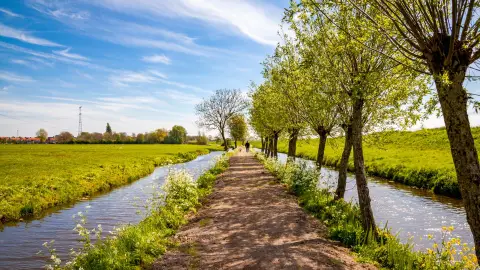
Walk 6 km through the quiet Robbenoord Forest and the Dijkgatsweide — a water-rich bird paradise on the Afsluitdijk in the northernmost part of North Holland.
Bird paradise on the edge of the polder
Somewhere at the very northern tip of North Holland, right up against the Afsluitdijk, lies a world that most walkers never find. The Dijkgatsweide Route (red) takes you nearly six kilometers through a lush post-war forest, small ponds, and rare birds, within walking distance of Wieringerwerf. It is a quiet, little-known route with a special story in the ground beneath your feet.
Through forest and open meadow
You depart from the starting point on Sluitgatweg near Wieringerwerf. You immediately step into the Robbenoordbos: a lush swamp forest with alders, downy birches, and beeches. Sunlight filters through the canopy, and salt-loving plants such as sea aster grow in the damp undergrowth. This forest is home to a large population of roe deer, and the chance that one of them will cross your path is real — especially in the early morning.
After a stretch of forest, you walk into the Wierholt: a semi-open, undulating nature reserve created in 2005 on a former landfill. The winding paths and unexpected topography make it a surprising passage. A viewpoint offers an unobstructed view of the landscape.
Then the Dijkgatsweide opens up before you — a water-rich, open area with small pools, reeds, and salt-loving riparian vegetation. The former meadows were transformed into a bird paradise in 2008. From the observation tower, you scan the meadow area: grey geese, spoonbills, waders, and who knows, a kingfisher shooting across the water like a blue flash. The route then follows the edge of the forest back to the starting point.
Highlights along the way
- Dijkgatsweide Observation Tower — From this tower, you have an unobstructed view of the water-rich bird paradise. Ideal for spotting geese, waders, and, with luck, the kingfisher. Bring binoculars.
- Het Wierholt — This semi-open nature reserve was created in 2005 on a former landfill, featuring undulating paths and a ridge with a view — surprising and full of character for a flat polder.
- Roe deer in the Robbenoord Forest — The forest is home to a large population of roe deer. The chance of an encounter is greatest in the early morning and around dusk.
A polder with a turbulent past
The Wieringermeer was drained in 1930 and developed into a flourishing agricultural polder. But on April 17, 1945, the retreating Germans blew up two dikes: within two days, the entire polder flooded. The newly planted Robbenoord Forest disappeared and largely died off. After the liberation, everything was replanted. As a gesture of reconciliation, Germany donated two groups of roe deer to the forest — their descendants still roam there. The landscape itself is a reminder of its saline, wet past: seepage water, salt-loving plants, and a vastness that echoes the former seabed.