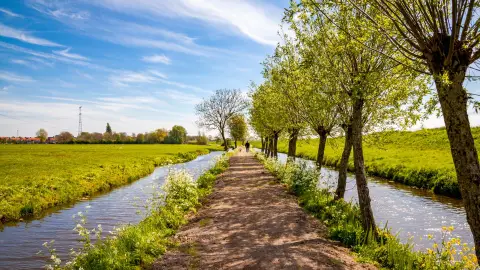
Walk from the Robbenoordbos along the Zuiderhaven of Den Oever and across the historic Wieringen polder — 12.2 km of nature and polder history.
Edge of the polder, edge of the world
The Wieringerrand Route (orange) is an unexpectedly rich walk in the northernmost part of North Holland. You trek through the Robbenoord Forest — one of the oldest polder nature reserves in North Holland — and follow the edge of the Waard-Nieuwlandpolder to the Zuiderhaven of Den Oever. Here, right up against the Afsluitdijk, you can feel how man has reclaimed this land from the water. The route is a circular route, marked in both directions with orange arrows.
Narrow paths and vast polder land
You start at the Robbenoordbos, a Staatsbosbeheer forest area that was created in the 1930s on reclaimed seabed. The forest air is immediately noticeable: it smells of pine and damp earth. Along narrow, unpaved paths—covered with moss, ferns, and mushrooms—you walk through a forest full of character. In autumn, the palette of colors is at its richest; in spring, it is filled with birdsong.
You cross the Sluitgat via a cable ferry — a special moment when you literally feel the water beneath your feet. On the other side, the landscape opens up: you enter the Waard-Nieuwlandpolder, reclaimed in 1847. The grassy dikes and vast meadow landscape create a sense of space and silence rarely found elsewhere in North Holland. Den Oever approaches slowly, with the Zuiderhaven and the contours of the Afsluitdijk on the horizon. Those who look closely can see the towers of the Frisian coast in the distance.
The route runs partially parallel to a bicycle tunnel; on that section, follow the walking path to return to the forest. The path is unpaved, narrow, and authentic — ideal for those who appreciate the adventure of a real forest walk.
Highlights along the way
- Robbenoordbos — An extensive polder forest of about 750 hectares, created after the land reclamation in 1930. A green, quiet woodland in the middle of the polder with a rich undergrowth of mosses, ferns, and mushrooms. Wonderful to lose yourself in.
- Pull ferry across the Sluitgat — A charming pull ferry connects the two sides of the route. Crossing by ferry adds a surprisingly playful touch to the walk and is a unique experience for children.
- Grasdijk Waard-Nieuwlandpolder — The route runs along the historic grass dike of the Waard-Nieuwland polder (1847). From the dike, you have a sweeping view of the open polder landscape and sit literally on the edge of old and new land.
- Zuiderhaven Den Oever — The coastal village of Den Oever is the pivot point of the route. The Zuiderhaven has an authentic character with fishing boats and the proximity of the Afsluitdijk. A good moment for a rest break or a cup of coffee in the village.
- Robbenoordbos Fish Passage — A new fish passage was constructed along the forest in 2021. This ecological structure is a fine example of nature restoration and can be admired from the walking path.
Land reclaimed from the sea
The Wieringermeerpolder — drained in 1930 — is one of the first major land reclamation projects of the twentieth century. Before that time, this area was an inland sea between the northern tip of North Holland and the island of Wieringen. The Robbenoordbos and the Waard-Nieuwlandpolder (1847) together form a layered landscape of reclaimed land: each piece of land has its own age and story. Den Oever, traditionally a fishing port, lies exactly on the border of old Wieringen and the new polder.