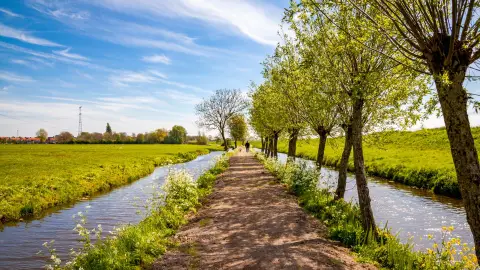
Quiet circular walk through Dijkgatbos and Robbenoordbos in the Wieringermeer — past meadows, a lookout tower, and a bird paradise.
Deep in the polder forest
Here, at the northernmost point of North Holland, lies a place that most people never find. The Dijkgatbos and the Dijkgatsweide — a water-rich bird paradise that silently awaits those who take the trouble to come. The Dijkgatsweide Route (black) is a circular walk of approximately 6 kilometers that starts from the Dijkgatbos, leads northwards past open nature and the IJsselmeer, and brings you back to the starting point via the Dijkgatsweide. The route is part of the walking network in the Wieringermeer, managed by Staatsbosbeheer.
Forest, meadow and sweeping vistas
You start in the Dijkgatbos, a varied deciduous forest that was planted in the 1930s after the draining of the Wieringermeerpolder. Beeches, alders, poplars, and birches alternate. In the early morning, you can hear the woodcock and the golden oriole here; at dusk, roe deer sneak along the paths. The forest is quiet, the path narrow — this is not a tourist attraction but a true nature spot.
After the forest, the landscape opens up. You walk north along the Dijkgatsweide, a wet nature development area that has been made accessible to walkers. Due to seepage from the IJsselmeer, it is very wet here: small puddles and pools sparkle among the reeds. Salt-loving plants such as sea aster color the grassland purple in late summer. Waders, geese, and ducks forage in the puddles; if you are lucky, a kingfisher shoots across the water like a blue spark.
From the observation tower, you have a sweeping view over the meadow and the adjacent IJsselmeer. A little further on, you walk back along the unpaved IJsselmeer dike, with vistas over the polder and open water. It is the kind of landscape that breathes — spacious, quiet, and almost empty.
Highlights along the way
- Dijkgatbos — Varied polder forest with beeches, alders, and poplars. Home to roe deer, foxes, woodcocks, and golden orioles. In spring, a green tunnel full of birdsong.
- Dijkgatsweide — Water-rich seepage area full of reeds, pools, and salt-loving plants. A hotspot for waders, geese, and ducks — and the occasional kingfisher.
- Observation Tower — Climb the tower for a panorama over the meadow and the IJsselmeer. During the breeding season, a unique window onto birdlife up close.
- 1945 Flooding Monument — At the beginning of the route stands a monument commemorating the deliberate flooding of the polder by the German occupiers, just before the liberation. A quiet, impressive place.
A polder with a story
The Wieringermeerpolder was drained in 1930 and soon became a fertile agricultural polder. But just before the liberation, in April 1945, the Germans blew up the dike. The seawater flowed back. Trees were planted on the sand that remained after the draining — this is how the Dijkgatbos came into existence. In 2008, the Dijkgatsweide was established as a nature development area, where groundwater seepage enables a unique flora and fauna. Knowing this, one walks the route with different eyes.