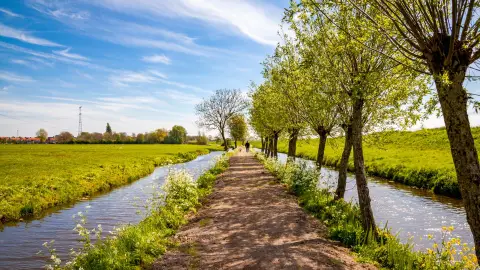
Walk 5.5 km through the quiet Robbenoord Forest near Wieringerwerf — along water, small bridges, and with a chance of spotting roe deer in the Wieringermeer.
Hidden in the polder
Hardly anyone has strayed from the beaten path, but in the northeastern tip of the Wieringermeer — just below the Afsluitdijk — lies one of the most unexpected forests in North Holland. The Robbenoordbos is a quiet, green spot in the middle of a polder landscape of open fields and wide skies. The yellow network walking route takes you 5.5 kilometers deep into the forest, along the water and over winding unpaved paths. A route that few people know, but one that stays with you.
Narrow paths, wide view
From the starting point on Sluitgatweg in Wieringerwerf, you step almost immediately into the seclusion of the forest. The yellow arrows lead you along narrow, unpaved paths on the eastern side of the Robbenoordbos. Beeches, oaks, birches, and poplars form a closed canopy above your head — and when the wind plays through the trees, you hear the quiet hum of windmills in the polder in the distance. That might sound more disturbing than it is: after a few minutes, you hardly notice it anymore.
Along the way, you will pass by the water in several places. Seepage canals and ditches crisscross the forest; sometimes you cross them via a small wooden bridge. In the morning, mist still hangs over the water here and the call of a kingfisher can be heard. If you go in the autumn, the forest is a true treasure trove: dozens of mushroom species stand out on the forest floor, from bright red fly agarics to nameless white cap toads. During the breeding season (roughly March through July), some paths may be temporarily closed to give the birds peace and quiet — check the current situation before departure.
If you are lucky, you might encounter a roe deer. Roe deer live in the forest and regularly move to the edges of the Dijkgatsweide. The chances are greatest early in the morning or late in the afternoon.
Highlights along the way
- Narrow forest paths along the water — The heart of the route: unpaved paths winding along seepage canals and ditches, with small wooden bridges where you get a close-up view of the water. It doesn't get quieter than this in the northernmost part of North Holland.
- Kingfishers and woodland birds — The Robbenoord Forest lies on the migration route of special bird species. Kingfishers can frequently be heard and seen here along the water's edge. Bring binoculars.
- Mushrooms in autumn — Anyone walking in September, October, or November will encounter a rich variety of mushrooms on the forest floor. Autumn is the perfect time to visit this forest.
A forest that shouldn't have been there
The Wieringermeer was drained in 1930. However, the northeastern corner proved to be of little agricultural value: the subsoil was too poor for farming. The advice at the time was to turn it into forest. This is how the Robbenoordbos came into existence, with the first planting taking place between 1934 and 1941. In April 1945, the Germans flooded the polder — the young forest barely survived. After the war, it was replanted. Today, Staatsbosbeheer manages this varied forest area of approximately 750 hectares, which is home to roe deer, martens, mushrooms, and dozens of bird species.