Discover places that play an important role in the LGBTQ+ history of Amsterdam. This route takes you past monuments, entertainment areas, and places of remembrance in the city center.
1. Homomonument
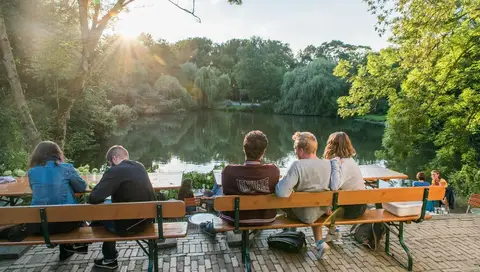
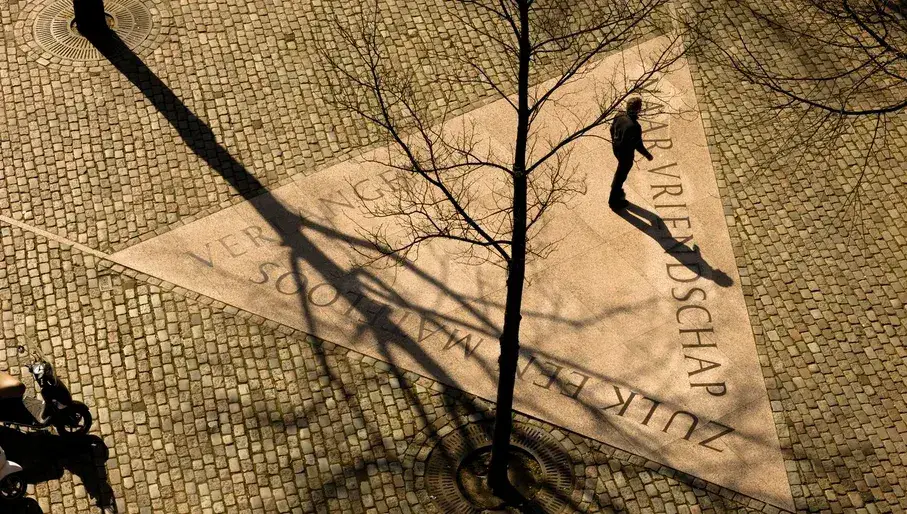
The Homomonument has stood on the Keizersgracht since 1987. This is the world's first gay monument. You might easily walk right past it, but the monument is situated on a hard-fought location on the Keizersgracht, behind the Westerkerk. Not tucked away, but right in the middle of the city. The sculpture consists of three interconnected pink triangles: past, present, and future. One pink triangle refers to the Second World War, when homosexuals were forced to wear this triangle in the concentration camps. Also read the line of poetry by Jacob Israël de Haan from 1914: 'Such an immeasurable longing for friendship'. Here, friendship represents the love that was not allowed to exist for centuries. In the present, you can sit here, muse, and watch the boats sailing by. The flowers you sometimes see lying here are for deceased friends and loved ones, for LGBTQ+ people who were not allowed to exist or who were ostracized. This became particularly visible during the AIDS epidemic and continues to have an impact in various ways to this day.
Homomonument | Westermarkt
2. Scaffold on the Dam
Who doesn't know the balcony scenes with Beatrix, Juliana, and King Willem-Alexander and Queen Máxima at the Royal Palace on Dam Square? In the 17th and 18th centuries, the scaffold for the city's executions stood here. At the time, homosexuals were called sodomites. Sodomy was a term for allegedly unnatural sexual acts, which carried the death penalty. So, you are standing here on a spot where hundreds of homosexual men met their death.
Palace on the Dam | Nieuwezijds Voorburgwal 147
3. Gay Capital
From the 1990s through the beginning of the 21st century, Amsterdam was considered by many to be the gay capital of the world. As an LGBTQ+ person, this was the place to be. This is where it was happening. In other countries, the community was often still suppressed, but not in Amsterdam. A changing society meant you didn't have to hide as much. New clubs, pubs, and gay bars sprang up like mushrooms. There were parties every night, from late at night until early in the morning. You danced in the Reguliersdwarsstraat at iT (now Club AIR), Richter, and RoXY, with a famous Gay Night on Wednesdays. If you had a leather fetish, you were in the right place in the pubs on the Warmoesstraat, and if you loved Dutch folk music, you headed to the Halvemaansteeg. There was something for everyone.
4. The Basket
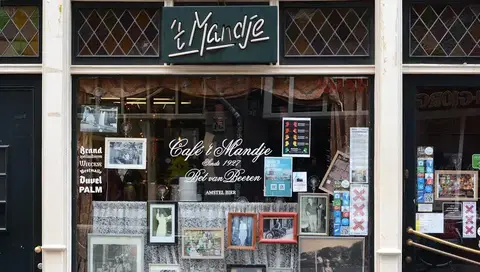
Long before the heyday of the 90s, there was the Zeedijk. The Zeedijk has always been a place where worlds met. Anyone seeking entertainment found it here. In 1927, Bet van Beeren, a working-class woman from the Jordaan, bought the pub at number 63 on the Zeedijk from her uncle. Bet named her pub 't Mandje. Bet was openly lesbian. Everyone knew that, and for no one who knew her was it a problem. Consequently, the pub became a sanctuary for LGBTQ+ people, and at that time, especially for gays and lesbians. And this despite the fact that back then, a gay person could still go to prison for three months for engaging in 'immoral behavior'.
Café 't Mandje | Zeedijk 63
5. In the resistance
LGBTQ+ resistance heroes in World War II? Absolutely. In 1943, the resistance carried out an attack on the population register. The Germans were not amused and offered a reward. The men were caught and executed. Soon after, it became clear that some of the key fighters in the resistance were openly gay or lesbian. In post-war Netherlands and Amsterdam, the persecution of homosexuals increased and homophobia ran rampant. People preferred not to know that there were openly gay and lesbian people fighting against the Germans. A forgotten chapter, about which you can learn more at the Resistance Museum. Want to delve even deeper into the history and background of the LGBTQ+ community? At OBA Oosterdok, you will find IHLIA, the leading heritage organization for LGBTQ+ in the Netherlands. The archive holds a unique collection of books, archives, and photographs that tells the history of a part of society that was invisible until recently. There is an IHLIA information desk with part of the book collection, and there are various exhibitions throughout the year.