Set out to visit places that commemorate famous and influential women from the history of Amsterdam.
1. Major Bosshardt (1913-2007)
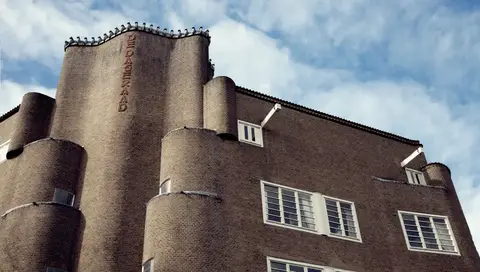
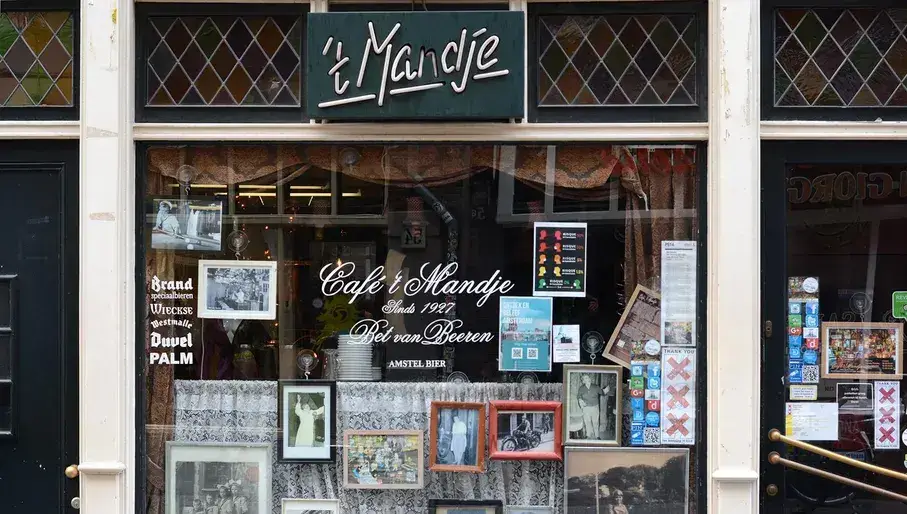
For a long time, this building was the workplace of Major Bosshardt, the Netherlands' most beloved Salvation Army soldier. As an 18-year-old girl, Alida Bosshardt joined the Salvation Army. During the Second World War, she worked in a Salvation Army children's home and helped countless Jewish children go into hiding. Bosshardt always felt a deep connection with prostitutes and the homeless. With a starting capital of 100 guilders, she established the first Goodwill Centre in Amsterdam's Red Light District in 1948. She often visited the cafes in the red-light district, including 't Mandje owned by Bet van Beeren, with whom she maintained a warm friendship. Bosshardt retired in 1978, but continued giving lectures and selling *De Strijdkreet* until she was 92. A bridge has also been named after Major Bosshardt as a posthumous tribute to her great services to Amsterdam and its people. The bridge over the Oudezijds Achterburgwal, between the Oudekennissteeg and the Molensteeg, lies in the middle of the major's former work area.
2. Aletta Jacobs (1854-1929)
Aletta Jacobs was the first woman in the Netherlands to graduate as a physician. She dedicated herself primarily to the care and well-being of women, and particularly to prostitutes. After obtaining her doctorate in 1879, she began working as a general practitioner in Amsterdam. She held free consultations for working-class women and prostitutes, provided information on hygiene and sexually transmitted diseases, and introduced the diaphragm as a contraceptive. Jacobs wrote publications and gave lectures both at home and abroad on prostitution, the use of contraceptives, and the importance of birth control. Aletta Jacobs is also regarded as the founder of feminism in the Netherlands. She fought for improved working conditions for women and for women's suffrage. In 1903, she left her medical practice to take over the leadership of the Association for Women's Suffrage. In 1919, the goal was achieved: women were granted universal suffrage.
3. Widow Johanna Borski (1764-1846)
In the Beurs van Berlage, built in 1903, grain, goods, and securities were traded in the first half of the last century. In Johanna Borski's time, the Merchants' Exchange stood in a different location, namely at the corner of Dam and Rokin. Although women were not welcome on the trading floor in her day, Borski managed to turn this to her advantage. As the widow of Amsterdam's second wealthiest resident, and endowed with great business talent, Borski continued her husband's business in 1814. Anyone wishing to do business with Widow Borski had to request an audience at her home. She led the company to the top of the Amsterdam money market. When the newly established Nederlandsche Bank failed to fully subscribe its share issue in 1816, Widow Borski took over the remaining 40 percent. The condition was that no new shares would be issued for three years, so that she could sell her shares at a profit. Later, she provided the Nederlandsche Handel-Maatschappij with substantial credits secured by securities. In doing so, she laid the foundation for what is now ABN AMRO. With a fortune of around 4 million guilders, Borski must have been one of the richest people in the country.
4. Marretje Arents (1712-1748)
In the 17th and 18th centuries, the Royal Palace on Dam Square still served as the city hall. From here, the city was governed, money was exchanged, and justice was administered. Once a verdict had been passed, the condemned person was taken to the Weigh House, in the middle of the square, and executed there. One of the women who stood trial here was Marretje, or Mat Arents, also known as the "lime woman," because she traded in limes, plaice, and herring. She became notorious for her participation in the Tenant Farmers' Revolt of 1748, during which 19 houses belonging to tenant farmers and tax collectors were plundered within a few days. When two rebellious citizens were shot, Marretje went with a group of bystanders to the impostmaster's house and smashed the windows. The following day, she went with others to the chief officer and threatened that he and other high-ranking gentlemen were not yet safe. As a farewell, she lifted her skirts and shouted: 'Now you can clean my ass, because that is how much I would do for you.' After the riots, Marretje was arrested and locked up beneath the town hall. At first she denied it, but after being threatened with the rack, she confessed everything. The sentence was: death by hanging. As she was hoisted out of the window of the Waag on a pulley, she kept screaming for revenge and struggling until she lost her life.
5. Annie MG Schmidt (1911-1995)
Before the war, the KAS BANK building housed the editorial offices and printing press of De Telegraaf. When this newspaper was banned from publication in 1945, the building was allocated to Het Parool and Trouw. In 1948, Annie M.G. Schmidt began working as a documentalist at Het Parool. She contributed to the newspaper occasionally, but her real writing career began with the sharp cabaret texts she wrote for the journalistic cabaret De Inktvis, encouraged by colleagues such as Simon Carmiggelt, Jeanne Roos, and Wim Hora Adema. Soon, she was delivering texts for Het Parool almost weekly: columns, nursery rhymes like Dikkertje Dap and Het schaap Veronica, and children's stories like Jip en Janneke, together with illustrator Fiep Westendorp. Meanwhile, Schmidt also wrote cabaret texts for Wim Sonneveld and Wim Kan. In 1957, she left Het Parool because she wanted to have time to write plays for radio, theater, and television, such as De familie Doorsnee, Pension Hommeles, and Ja zuster, nee zuster. They remained highly influential on Dutch culture.
6. Haesje Claes (1520-1581)
Haesje Claes is often named as the founder of the Burgerweeshuis, the current Amsterdam Museum, on the Nieuwezijds Voorburgwal. Haesje Claes and her husband, Claes Jacobsz., belonged to the wealthy upper class of Amsterdam. The couple lived on the Warmoesstraat, in one of the most beautiful houses in the city. Pontanus is the first historian to mention Haesje Claes' name as the founder of the Burgerweeshuis around 1600. Later historians have adopted his account. In 1886, historian Jan ter Gouw cast doubt on her reputation because he found no trace of her involvement in the archives. The only honor he granted her was that of founder of the Old Men's and Women's House. Nevertheless, there have since been historians who found indications that Haesje Claes must indeed have been involved in the founding of the orphanage. Because historians still contradict each other, it remains a mystery what role she actually played.
7. Johanna Reynvaan (1844-1920)
Johanna Reynvaan is also known as the founder of Dutch nursing. As the daughter of a wealthy tobacco merchant, she received her education at home from a governess. Because she wanted to give more meaning to her life, she hoped to make herself useful in nursing. In her circles, people began to realize that the nursing profession could be a respectable profession for unmarried women from the educated class. Thus, Reynvaan completed the first Dutch training program for lay nurses, which had been established by Jonkvrouw Jeltje de Bosch Kemper. She received her practical training at the Binnengasthuis in Amsterdam, where patient care was still of a low standard and care was in the hands of untrained, often rough servants and maids. In 1881, Reynvaan offered her services at the Binnengasthuis. She was accepted, but the changes she wanted to implement met with strong resistance. A year later, she therefore transferred to the Buitengasthuis on the Overtoom. Although she received a warmer welcome there, the state of hygiene and patient care was even more deplorable. In 1883, Reynvaan was appointed deputy director. Together with the progressive director Jacob van Deventer, she worked on improving healthcare and modernizing nursing. She established a nursing training program that became a blueprint for other training programs in the country.
8. Special Collections of the University of Amsterdam
If you want to know more about women in Dutch history, visit this library as well. Here you will find even more stories.