Discover the Amsterdam School in the city. This route shows how expressive forms, ornamental brickwork, and sculpture come together in the architecture of Amsterdam South.
1. Henrick de Keijserplein
Hendrick de Keyser came from a family of sculptors. In the early 1590s, De Keyser came to Amsterdam, where he became city architect and stonemason in 1595. He designed a variety of buildings, such as the East India House and the Westerkerk. The latter was completed by his son Pieter after his death and would become his most famous work. In addition to these buildings, he also designed and built residences for wealthy private individuals. Famous examples include the House with the Heads (Huis met de Hoofden), possibly designed by him, and the Bartolotti House. Whether the Bartolotti House is his work is disputed from various quarters. Hendrick de Keyser died in 1621 and is buried in the Zuiderkerk, which he designed. His tombstone can still be seen there.
2. Cooperative Court
This housing complex from 1927 was originally a combination of three residential blocks containing workers' housing, a meeting room, and a reading room for the emancipation and upliftment of the workers. A keystone by sculptor Jan Trapman above the entrance to the reading room, depicting books, trees, a key, and a snake, still commemorates the central building's original function as a public reading room. Trapman drew inspiration for his sculpture from Artis Zoo. The old library with the grey clock tower stands to the right of the square and was used as a public library until the 1980s. Stylistically, this building is the most interesting. The tall clock tower symbolizes the intellectual uplift of the worker. The interior featured decorations of an edifying nature. The meeting room was initially located on the ground floor. In the center of the square stands a spherical monument commemorating public housing pioneer Lucas van Buuren. Before leaving the square, also look at the corners of the houses. These are rounded, with inverted battlements at the bottom.
3. Thérèse Schwartzeplein
A beautiful example of Amsterdam School architecture by Michel de Klerk, built between 1919 and 1922. You can see four trapezoidal houses, each containing six dwellings. The two upper floors feature an attic with a gently sloping roof. The trapezoidal shape created an opening that widens towards the top. A balcony is situated between them. On the second floor is an extra-large living room, as one of the bedrooms is located in the attic. On the corner next to house number 1, a sandstone artwork by Jan Heijens from 1930 can be seen. It is a rounded gable stone created during the construction of the De Dageraad housing complex. It depicts the harvest, featuring four figures and a rooster on a sheaf of corn. While in Thérèse Schwartzestraat, also take a look at the beautiful porticoes with rounded arches above. Here, too, you can see the use of two-tone brickwork.
4. Berlage Lyceum
This part of the Berlage Lyceum features two remarkable architectural sculptures by Hildo Krop. The details are difficult to distinguish, but they depict a group of human figures. Above, you see a pregnant woman with a bunch of grapes; below, a man with spread and muscular arms and legs. Furthermore, there are sculptures that refer to trade, industry, and agriculture. All of this refers to the second commercial school that was once located here.
5. The Dawn
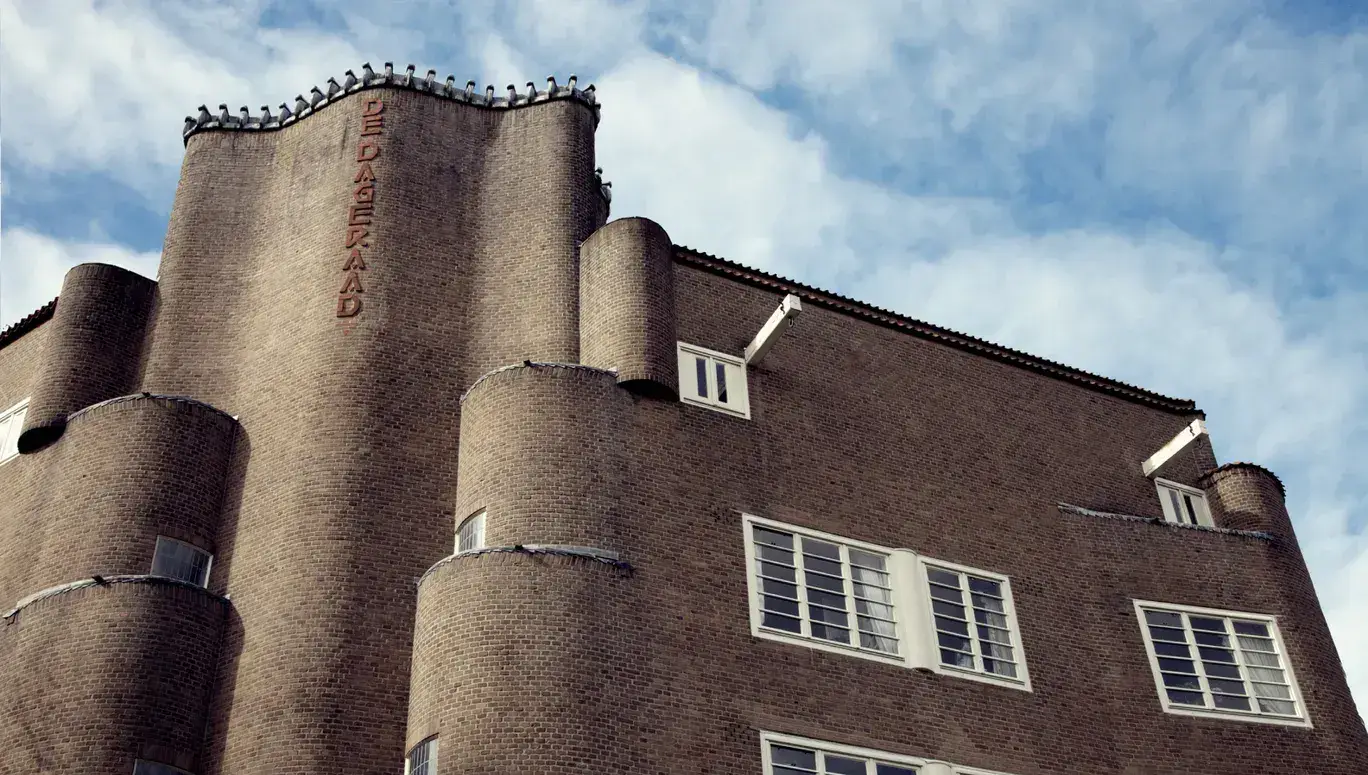
This residential complex is one of the aesthetic highlights of the Amsterdam School. The name De Dageraad can be found in brick on the facades. The complex is built of three colors of brick, with asymmetrical windows, turrets, and small round balconies at the corners, topped by a steamship-style chimney. The roofs here resemble waves of the sea. A memorial stone in the corner house on the right commemorates the architects Michel de Klerk and Piet Kramer. The text in the left tower is dedicated to Pieter Lodewijk Tak.
6. Van Woustraat
On the way to this point, on the corner of Talmastraat, stands a residential complex with two floating brass arches. These were not installed until 1987. Homes with trapezoidal windows can also be seen. Van Woustraat is named after bell founder Geert van Wou. Beautiful buildings with typical features of the Amsterdam School stand on this street. The house across the bridge, bordered on one side by Jozef Israëlskade and on the other by Amstelkade, was built in 1921-1922 by architect GJ Rutgers. The house has many projecting sections, giving it a certain rhythm. The round towers on the roof are almost works of art in brick.
7. Victorieplein
On the way to this point, beautiful buildings with extensions and turrets can be seen. Also note the windows: all different in shape and size. Victorieplein was formerly called Daniël Willinkplein, after the poet Daniël Willink, known for, among other things, *Amstellandsche Arkadia* and other writings about the beauty of the city. The name was later changed in remembrance of the Allied victory in May 1945. Amsterdam's first skyscraper also stands here: twelve stories and 46 meters high. The building was designed between 1930 and 1932 by architect Jan Staal. It displays characteristics of the Amsterdam School, Functionalism, and New Objectivity.