Discover Amsterdam through romantic, wondrous, and sometimes moving stories associated with iconic buildings and locations.
1. Anne Frank House
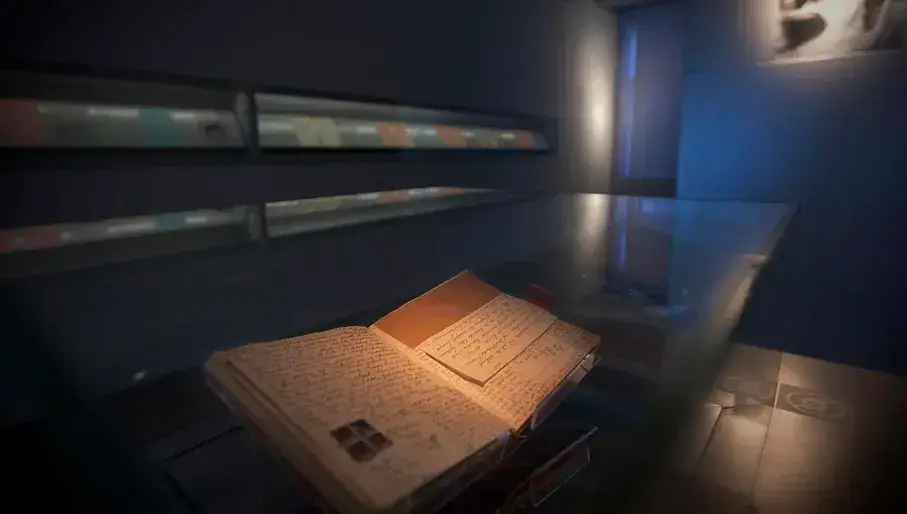
You have probably been here before and, of course, you know the story of Anne Frank, but did you also know that Anne was in love while she was hiding here? This is the story of Anne and Peter, and of their first kiss. In the summer of 1942, the Frank family moved into the Secret Annex, after Father Otto had created hidden living space in that part of the house—previously used as business storage—when public life was no longer safe for Jews. Not long after, the Van Pels family joined them, an employee of Otto and his family. Anne looked forward with anticipation to the arrival of the new people, especially to son Peter, who was only two years older than her. Anne longed for a boyfriend and had always gotten along well with boys. But Peter disappointed her. Anne found him boring, withdrawn, and struggled to connect with him. He 'loafs around on his bed all day, hammers a bit, and then goes back to sleep,' she wrote in her diary. A year went by like this. One day, Anne looks at Peter during dinner and realizes that he might be going through the same thing as she is. Perhaps he feels lonely too and could use a friend. She decides to give him a chance. Anne starts visiting Peter in his own room in the attic. A friendship develops. Together, they look through the attic window at a white horse chestnut tree, the connection to the outside world, and they dream about what they would do if they were free again. One evening, they talk about their future, and at that very moment, bombs fall on the city. Anne is startled and pulls Peter close to her, as if she is protected from the bombs in his arms. They look into each other's eyes. Anne realizes what she is doing and is shocked by herself. She cannot sleep that night. Has she fallen in love with Peter? A few weeks later, they are alone in the attic room again and they kiss. Anne's very first kiss. Anne and Peter fell in love, but only a few months later, the families were betrayed. To this day, we do not know who did it. After their arrest, the families ended up in transit camp Westerbork. According to a fellow prisoner, Peter and Anne spent a lot of time together there. On September 3, Peter and his parents had to go with a transport to Auschwitz-Birkenau. Anne and Peter see each other for the last time on the platform.
2. Westerkerk
Right next to the Anne Frank House stands the Westerkerk, designed by Hendrick de Keyser and built as a Protestant church for the workers who lived in the Jordaan. The famous painter Rembrandt van Rijn is buried here. He lived at Rozengracht 184, the street parallel to the church. During his life, he was sometimes rich, sometimes poor. He died in 1669 as a poor man. Rembrandt was therefore buried in a rented grave, and his exact location is unknown. His wife Saskia died earlier, in 1642, at the height of Rembrandt's career, and has her own grave elsewhere. Further along this route, you will discover where she is buried.
3. Homomonument
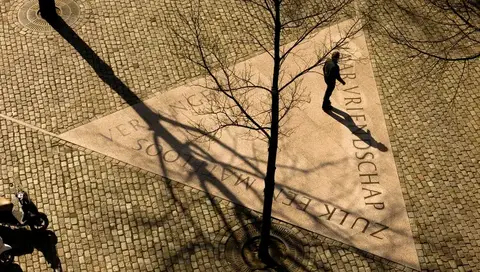
Being able to express love has not always been a matter of course for everyone. Not so long ago, being openly in love with someone of the same sex was not possible, and was even punishable by law. In the Netherlands, homosexuals were not actively rounded up by the Nazis during World War II, but one still had to be careful. In the concentration camps, every prisoner was required to wear a distinguishing mark. The most famous is, of course, the yellow Star of David for Jews, and for homosexuals, it was a pink triangle. After World War II, the COC was founded, an organization actively committed to the rights of LGBTQ+ people. This ultimately led to more rights and the cessation of persecution. The triangle became the COC's symbol for the emancipation of LGBTQ+ people. In 1987, the Homomonument was unveiled. The design is based on the pink triangle. Gatherings are held at this site to commemorate violence against LGBTQ+ people, during the war and elsewhere in the world.
4. The New Church
The Nieuwe Kerk traces its origins back to the 14th century. Hundreds of weddings have been performed here, including, of course, that of King Willem-Alexander and Queen Máxima. They married on February 2, 2002. It is known that they met at a party in southern Spain. Máxima was working in New York at the time, and because no one knew Willem-Alexander there, he was able to get to know Máxima at his leisure. Princess Beatrix, then still Queen, was often critical of her eldest son's girlfriends, but Máxima was welcomed with open arms. The Netherlands embraced her as well. Undisputedly the most romantic moment of the wedding ceremony was the tango, played on a bandoneon by Carel Kraayenhof. Máxima's emotion even went down in history as 'Máxima's tear'.
5. Old Church
The Oude Kerk is the oldest building in Amsterdam, completed in 1308. Many people are buried in this church, but the most famous person on this route is Saskia van Uylenburgh, the wife of Rembrandt van Rijn. Once a year, the sun shines through a window and Saskia's grave is illuminated. This happens on March 9 at 8:39 AM. Some people believe that this is the day and the exact time Saskia and Rembrandt met for the first time. The Oude Kerk is now a museum and often hosts concerts and exhibitions. During the summer months, you can also climb the tower for a beautiful view of the old city center.
6. The Weigh House
The Waag is the fairytale-like building in the middle of the Nieuwmarkt. There are no castles in Amsterdam, but the Waag perhaps comes closest to them. Originally, the Waag dates back to 1450, when it was much smaller and used as a gateway. There was an old drawbridge, and a moat had been dug in front of the walls. The canals used to run in front of this building, and water still flows underneath it. If you look to the right and left, you can still recognize the old canals. Around 1600, Amsterdam grew due to trade and shipping. The city wall was demolished, and the gateway was converted into a weigh house. Here, ships had to have their goods weighed and pay taxes. Later, it became a clubhouse for various guilds. One of these was the doctors' guild, which organized a public autopsy every year. One of these dissections was captured by Rembrandt van Rijn and marked his major breakthrough. Nowadays, there is a restaurant in the Waag. With its heavy walls, towers, and location on the square, this remains one of the most romantic and wondrous buildings of the city.
7. Rembrandt House
You are standing in front of Rembrandt van Rijn's old house. This painter's love story is full of drama and suffering, but it all began promisingly. Rembrandt was born the son of a miller in Leiden. The intention was for him to become a miller as well, but Rembrandt had other plans. He wanted to become a painter. As soon as he finished his work at the mill, he would head out, observe the light, and try to capture it in his paintings. When he was old enough, he left for Amsterdam. There he met Hendrick van Uylenburgh and his cousin Saskia. Rembrandt asked Saskia to model for his paintings. Saskia was honored and accepted the offer. She posed in his studio, and in moments of silence, sparks flew. Saskia became Rembrandt's muse and lover. They married, bought this large mansion, and Saskia became pregnant. A fairytale marriage, or so it seemed. But the first child, a girl, died soon after birth, and the second and third children did not live long either. With every loss, Saskia lost a little of herself, and her heart closed off more and more. She became pregnant again, and this time her son Titus survived, but shortly afterward, Saskia herself fell ill. All this happened while Rembrandt was at the height of his career. He was commissioned to paint a wealthy group of merchants, a major project for which a year was allocated. During that year, his wife passed away. Rembrandt decided to paint Saskia one last time: in The Night Watch, as an angel caught in a beam of light. Thus, she became one of the protagonists of his absolute masterpiece.
8. Staalmeestersbrug
From this bridge, you have a beautiful view of the Zuiderkerk. It is also the bridge where couples used to hang padlocks to make their love last forever. Now, those padlocks are regularly removed.
9. Tuschinski
Nothing is more romantic than an evening at the movies. Or rather: an evening at the cinema in Tuschinski, one of the most beautiful art house cinemas in the world. The cinema was built on the orders of Abraham Icek Tuschinski, a Jewish man who had amassed his wealth in the port of Rotterdam. Tuschinski was originally from Poland, the son of a tailor. He dreamed of emigrating to America but remained in Rotterdam: first as a tailor, later with a lodging house for emigrants, and subsequently he turned his attention to the increasingly popular cinema. In Rotterdam, Tuschinski built several cinemas. This went so well that he decided to try his luck in Amsterdam as well with a large art house cinema. On October 28, 1921, the Tuschinski cinema opened, having cost about 4 million guilders. It proved to be a great success. The building is a mix of various styles: Amsterdam School, Jugendstil, and Art Deco. During the bombing of Rotterdam in the Second World War, four of Tuschinski's cinemas were destroyed. His cinema in Amsterdam remained intact but fell into the hands of the Germans. Tuschinski was arrested and deported to Westerbork and later Auschwitz, where he died. To this day, Tuschinski is a beautiful cinema and hosts many Dutch film premieres. A romantic outing is therefore still guaranteed.
10. Stopera, Amsterdam City Hall
You are now looking out at Amsterdam City Hall, with the National Opera & Ballet on the other side. In this building, on the night of March 31 to April 1, 2001, a ceremony took place that had never been performed before. Just before midnight, four couples arrived. The international press crowded around to take a photo of the couples. For the first time in history, at the stroke of midnight, four same-sex couples were legally married here by Mayor Job Cohen. With this, the Netherlands had the world premiere of same-sex marriage. One of the couples decided to make a statement to the whole world: they did not put on a ring, but took a ring off their finger, revealing a ring that was already tattooed. 'Because this is not the day we get married. This is the day we show the whole world that we are already married, in our hearts.' Many other countries followed the Netherlands. This place thus marks a historic moment in the struggle for equal rights and in the history of love.
11. The oldest elm in the city
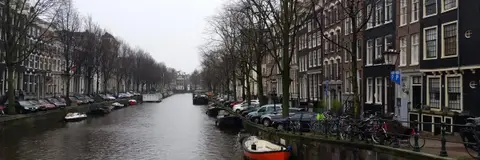
The smell of Amsterdam? Most people will think of the smell of weed, but another scent wafts through the streets of Amsterdam. We go back four centuries in time, to when most of Amsterdam's canals were constructed. These canals were dug to serve the growing port and to protect the city from flooding. They also served as open sewers. The former Zuiderzee caused tides, meaning a lot of dirt was regularly carried out of the city. Unfortunately, this did not always work well, and a large portion of the filth was left behind. As a result, the canals stank terribly. The municipality came up with a simple solution: the elm. Hundreds of elms were planted to remove the stench from the air and spread a fresher scent. The trees were never removed and remain a recognizable part of the cityscape to this day. Amsterdam currently has tens of thousands of elms. There is even an elm walking route featuring the tallest elm, the street with the most different types of elms, and much more. You are now standing in front of the oldest elm in Amsterdam, dating back to 1891. Every year, the trees create a remarkable phenomenon. In spring, the elms drop their white blossoms—the spring snow. The scent of the blossoms is distinctive and very recognizable to many people. The artist duo Tijdmakers was inspired by this and decided to capture the scent of elms in a perfume: Eau d'Amsterdam.
12. Skinny Bridge
The wooden bridge over the Amstel, the Magere Brug, is probably one of the most romantic and iconic bridges in Amsterdam. When evening falls, this bridge is illuminated by 1,200 lights. The lights reflect in the water, giving the place a romantic atmosphere. There is also a legend circulating, the origin of which no one knows exactly. It says that if you sail under this bridge and kiss your loved one, you will stay together forever. In some versions, it is even enough to kiss *on* the bridge. Add to that the sweeping view of the city and the river, and this could very well be the most romantic spot in the city.